
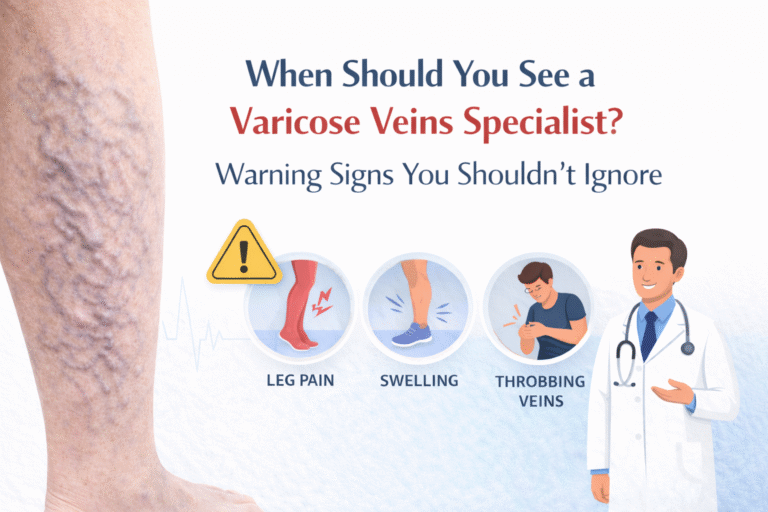
Introduction
Many people delay treatment for varicose veins, assuming they are only a cosmetic issue. In reality, varicose veins are a medical condition that can progress silently. Knowing when to consult a vein specialist can prevent serious complications. At Lumina Vein & Vascular Center, early referrals lead to better outcomes and faster recovery.
Early Signs That Need Specialist Evaluation
Consult a varicose veins specialist if you experience:
- Persistent leg pain or heaviness
- Swelling that worsens by evening
- Visible bulging or twisted veins
- Itching or burning over veins
These are early indicators of venous disease.
Advanced Warning Signs – Seek Care Immediately
- Skin darkening or thickening near ankles
- Bleeding from veins
- Non-healing wounds or ulcers
- Sudden redness and tenderness
Delaying treatment at this stage can lead to infection and disability.
Why Seeing a Specialist Matters
A vein specialist:
- Performs Doppler ultrasound evaluation
- Identifies hidden vein reflux
- Recommends personalized treatment
- Prevents recurrence and complications
General treatments without evaluation often fail.
Modern Varicose Vein Treatments Available
- Laser (EVLT) Treatment
- Radiofrequency Ablation (RFA)
- VenaSeal Glue Closure
- Foam Sclerotherapy
These procedures are safe, effective, and usually completed in a day.
Expert Opinion – Dr. Uday Ravi
“Varicose veins are progressive. The earlier you see a specialist, the simpler the treatment and the better the results.”
— Dr. Uday Ravi MBBS MS FMAS FIAGES FISCP FALS FARIS DMAS (France)
Consultant Vascular & Laser Surgeon
FAQs
Q1: Are varicose veins only cosmetic?
👉 No, they can cause ulcers, bleeding, and clots if untreated.
Q2: When is the best time to see a specialist?
👉 As soon as symptoms begin.
Q3: Do I need surgery for varicose veins?
👉 Most cases are treated without surgery using laser or glue.
Q4: How long does recovery take?
👉 Most patients return to routine activity within 24–48 hours.